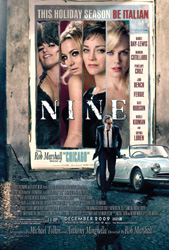
 Synopsis: A vibrant and provocative musical filled with love, lust, passion and glamour. A world famous film director reaches a creative and personal crisis of epic proportion, while balancing numerous women in his life. With its incredible all-star cast, amazing performances and stunning visuals, this razzle-dazzle extravaganza will make you long to be Italian.
***********************************************************************
Nine 6.75
eyelights: Marion Cotillard. the sumptuous locations.
eyesores: the bland songs. the horrible lyrics.
“What would you like to see that I haven’t already shown you?”
‘Nine’ is a musical based on Federico Fellini’s ‘Otto e mezzo‘. The title is a play on the original title, which means ‘8½’ (a reference to the Il Maestro’s number of films at that point in his career: author Yeston decided to call it “Nine” because, by adding music, it added an extra half number more to the total count.
Is that clever, pretentious or disingenuous?
Who cares? The fact is that this motion picture is based on a musical, that is based on a movie, that is based on Fellini’s experiences: it’s as close to inspired freshness as the book of the movie of the TV cartoon of the toy you used to play with as a child (guess which one I’m referring to!). Well, it’s not that bad. But it’s close.
‘Nine’ is about as vibrant as a plastic flower: it looks like a flower, and it’s pretty to look at, but it lacks the bouquet and tangible qualities that make the real thing appealing. If anything, ‘Nine’ lacks soul. The award-winning performers go through the motions, the musicians are bombastic, and the cinematography is glossy.
But it doesn’t feel real.
Oh, sure, it’s a musical, but it’s rooted in the sober reality of a man facing a personal and professional crisis and who seems incapable of preventing his own self-destruction. You can hardly get more real than that. And yet, somehow, the filmmakers (or is it the musical’s authors?) have managed to strip it of any true emotion.
Everything feels fake: from the cast’s vacillating accents (there were so many “Italian” accents that they all negated each other, so that none of them sounded Italian), to the anachronistic staging of the numbers (did the director even bother to study the period?) to the forever–polished cars (Italy is dust free, is it?), it was all a sham.
I didn’t even buy Daniel Day-Lewis’s performance as Guido, the film’s protagonist: it was far too cartoony at times (particularly in the first half of the picture). He was also in far too good a shape for a 50-year old. Or a movie director. Or a man from the ’60s. Honestly, he looked like a young man portraying an older man. Which he was.
Le sigh.
It doesn’t help that Guido is a contemptible, if not despicable, character: a serial liar, a cheat, a miserable, tortured man. There’s really not much that Day-Lewis could have done to make him remotely palatable, but he was poorly cast and it only made the whole of Guido hard to accept. I would have preferred Antonia Banderas, who played him on stage.
The rest of the cast was decent enough, but they really didn’t have much to work with, given that most of their parts were miniscule and with limited dialogue (considering the size of the cast, it’s not surprising). In fact, Marion Cotillard, who plays Guido’s spouse, has the most screen time of all the leading ladies with just over 17 minutes. And it’s a near-two hour film!
She was worth every moment, though. Although I’m not a huge fan of hers, she was by far the shining star of this whole lot. In fact, she also had the best of all the musical numbers (which isn’t saying much, frankly), with a classy, low-key, overview of her character, Luisa, and Guido’s relationship – not only was she pitch-perfect, but it suited the part and the era.
Kate Hudson had the next best one with an energetic number that was much like a music video, but that was set in a style that was more reminiscent of the mod flavours of the period. And Hudson gave a surprisingly convincing performance. I was rather impressed, given my expectations. Her speaking parts, however, were less remarkable and easily forgettable.
The film was also book-ended by these largely instrumental numbers featuring Guido and all the female cast members (backed by dozens of super sexy young dancers, naturally). Those were decent because, although the set was huge, the numbers weren’t too showy and there was hardly any singing; these felt more like overture and exit music.
The worst number of them all was Penelope Cruz’ introductory number: it had the shittiest lyrics ever, featuring rhymes so simplistic that I was guessing them in advance. I know that her character was a simpleton in the original film, but she isn’t played that way here, so it’s hard to excuse the lyrics as being “in character”. Cruz does her best, but it falls flat anyway.
What’s worse is that many of the stage musical’s numbers were excised (no doubt for time considerations), leaving behind some of its coherence: a number of references made in the picture are to numbers that are no longer present, such as when Carla refers to her previous stay at the hotel, or when the Cardinal talks about Charlie Chaplin. Heck, even the title song was cut.
Clearly, the writing is one of the film’s biggest drawbacks. It restructures the original story a little bit, but doesn’t improve on it. In fact, it often strips more from it than it contributes. The prologue and epilogue, for instance, are not in the original movie and are superfluous – as were Carla’s suicide attempt (and subsequent meeting with her husband) or Kate Hudson’s part.
I question the wisdom of stripping out core elements only to add others all the while reducing each sequence to a moment sandwiched between all-too-many musical numbers. The result is a barebones tale (and there wasn’t much meat on the original story to start with), so the numbers would have had to be terrific to compensate for this. Unfortunately, they’re not.
The strengths of the original were its satirical humour and its fantasy sequences. Without the humour and by substituting the fantasy sequences for these run-of-the-mill musical numbers, the fun of the original is sorely missing. All that’s left is one miserable man’s misery wrapped up in globs of gloss: there’s nothing to feel, no wit, no artistic merit. Just product.
At least the location shooting is spectacular. But I’d sooner watch a travelogue than watch ‘Nine’ again.
Date of viewing: May 22, 2014
 thecriticaleye