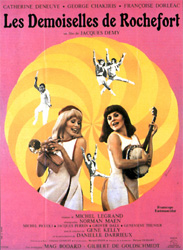
 Synopsis: A wonderfully entertaining musical fantasy, The Young Girls of Rochefort features big-screen legend Gene Kelly (That’s Entertainment) and international star Catherine Deneuvre (Belle De Jour) in a delightfully light hearted story about two charming sisters waiting for their perfect love to arrive! In the picturesque seaside village of Rochefort, Delphine (Deneuve) teaches dance while her twin Solange (Francoise Dorleac) composes and gives piano lessons. As the girls dream of success and romance in the far-off big city, they don’t’ realize that rue love may be just around the corner! An exuberant musical treat that earned rave reviews from critics everywhere, this beloved classic has been beautifully restored to its original magnificence!
***********************************************************************
Les Demoiselles de Rochefort 7.0
eyelights: Gene Kelly’s smooth moves. the large-scale yet unpretentious productions. the amusingly contrived romantic developments. the location shooting. the orchestrations.
eyesores: Deneuve’s stiff dance moves. the seemingly endless singing.
‘Les Demoiselles de Rochefort’ is Jacques Demy’s follow-up to his massively successful ‘Les Parapluies de Cherbourg‘. Unrelated to its predecessor (or ‘Lola’, the first of this loose “trilogy”) aside for some actors and references, it earned less praise all the while selling more tickets in its native land.
The picture takes place in Cherbourg, France, and concerns the love lives of a half dozen characters who are all interconnected and who, predictably, will all finish by pairing up.
- Delphine, as played by Catherine Deneuve, is a dance teacher who is unhappy in her relationship and stumbles upon a painting that resembles her while visiting her beau’s art gallery. Fascinated, she longs to meet the artist behind this canvas, but is railroaded by her beau (now ex) who wants to keep her by his side.
- Solange, as played by Françoise Dorléac, is a composer who falls for a random stranger on the street, not knowing that he is the world-famous American composer that she is scheduled to meet in Paris. She is Delphine’s twin and works with her in the same dance studio (Coincidentally, Dorleac is Deneuve’s actual sister).
- Yvonne, as played by Danielle Darrieux, is a bar owner who lives with the regret of having deserted her fiancé, and father of her son Boubou, a decade prior. She is also the mother of Delphine and Solange who, like Boubou, have never their own fathers. Yvonne is so busy that she can barely get away from work – but she maintains a sunny disposition.
- Max, as played by Jacques Perrin, is a sailor on shore leave. He is a painter whose true ambition is to find the ideal woman, and has visualized her in a painting that is on an art gallery wall in Cherbourg. He has traveled the world trying to find this daydream of his, not realizing that she looks very much like Delphine – whom he’s heard of but never met.
- Simon Dame, as played by Michel Piccoli, is the owner of a musical instruments boutique. He has returned to Cherbourg because it reminded him of his long lost love – who so happens to be Yvonne, whom he thinks is in Mexico with another man. He has a crush on Solange, unaware that she is Yvonne’s daughter, and is trying to help her in her career by setting up an appointment with his close friend, Andy Miller.
- Andy Miller, as played by Gene Kelly, is a world-famous composer. He has come to Cherbourg for a surprise visit to his old pal Simon Dame. As he gets lost in the city, he bumps into a young woman, Solange, whom he is immediately enamoured with and spends the rest of the picture trying to find her again. Little does he know that she works with Simon.
You can immediately see where it’s all headed, even though there are a few elements that will temporarily halt or side-track the characters’ winding trajectory towards each other – not the least of which are other suitors. And musical numbers.
Because, yes, ‘Les Demoiselles de Cherbourg’ is, like its predecessor, a musical.
The key difference between the two is that this one was conceived as an homage to Hollywood’s traditional brand of musical and, thus, it features song and dance numbers interspersed between bits of light drama – unlike the other one, which had no dancing whatsoever and all its dialogues were sung.
Honestly, after ‘Les Parapluies de Cherbourg’, this was almost welcome. I had to force myself to watch this, so traumatized was I, so having moments of reprieve from the musical was really nice. And I actually enjoyed some of the productions – not enough to love the film, but enough to survive it.
- The first musical number was a slow instrumental jam. It took place aboard the Rochefort-Martrou Transporter Bridge, which provided a surreal effect because it’s suspended above the river. Its corresponding choreography was a groovy sight – not an exuberant show-stopper. Nice. Plus one of the lead dancers had this deliciously dreamy sway of the hips.
- There was this sequence when Delphine is walking home, and the people around her are dancing in a variety of ways to an orchestral score. I loved that the lead didn’t participate (was pretty much oblivious to it, actually), there was no singing, and that the number merely embellished what would otherwise have been a mundane sequence. It had an arty quality that I rather enjoyed.
- Gene Kelly’s first number was amusing but superfluous, contrived – you could easily take it out of the movie and it wouldn’t change a thing. Still, he was really great for his age (55 at the time); his performance is smooth, and he seemed light as air.
I was most impressed with the quality of the score. While critics preferred the previous one, I enjoyed the fact that, since there were fewer vocals, Michel Legrand’s music shone through. I also enjoyed the fact that it was shot on location, instead of large-scale sets like many musicals are.
But it wasn’t all great: there was this wonky number where every main character sings their own song in turn, faded into one another. It really didn’t gel; it was disparate. Plus which the script was fluff of the like one gets in a sitcom. And the performers sometimes lacked precision, exactitude.
The worst of the lot was Deneuve, who was stiff, lacking in spirit (especially in comparison to her sister). In fact, she often appears to be given ways out of having to perform to a reasonable degree, like when she “teaches” the kids at the dance class – she does a few pathetic motions and that’s it.
In the end, the bottom line is that ‘Les Demoiselles de Rochefort’ is a decent enough musical. It’s certainly a better one than ‘Les Parapluies de Cherbourg’, and I suspect that musical lovers would really dig this. I, however, simply don’t enjoy this sort of thing. I appreciate its many qualities, but I was incredibly bored.
Although Demy and Deneuve paired up again for ‘Peau d’âne’, their biggest smash yet (it brought in as many cinemagoers as the other two combined!), there’s nothing that compels me to seek it out. I’ve seen two of their classics, and that’s plenty enough for me. I think that I’m ready to move on at this point.
Date of viewing: May 12, 2014
 thecriticaleye