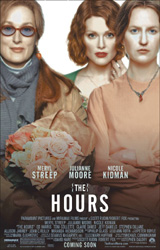
 Synopsis: THE HOURS tells the story of three very different individuals who share the feeling that they have been living their lives for someone else. Virginia Woolf (Kidman) lives in a suburb of London in the 1920’s as she struggles to begin writing her first great novel, Mrs. Dalloway, while also attempting to overcome the mental illness that threatens to engulf her. Laura Brown (Moore), a young wife and mother in post-World War II Los Angeles, is just starting to read Mrs. Dalloway, and is so deeply affected by it that she begins to question the life she has chosen for herself. Then, in contemporary New York City, Clarissa Vaughan (Streep) is a modern-day mirror image of Woolf’s Mrs. Dalloway as she plans what may be the final party for her friend and former lover, Richard (Harris), who is dying of AIDS.
***********************************************************************
The Hours 8.25
eyelights: Nicole Kidman. Julianne Moore. Meryl Streep. the message. the themes.
eyesores: Toni Colette’s unusually shiny teeth.
I’m not an especially well-read guy. I mean, I read a lot but, due to time constraints (given my other hobbies, I mostly read on the bus) I hardly ever tackle a traditional novel – I tend to stick with graphic novels. Picture books. Or “funnies” if you want to be more condescending. Some would even go so far as to say that I don’t actually read. This would be unfair, but I fully admit that my scope is relatively limited.
Of course, similar things could be said about someone who only listens to pop radio or only watches the latest Hollywood drivel – culture, or even just breadth of experience, demands time and concerted effort. Most people focus only in certain areas, limiting their overall scope, anyway. Furthermore, one can easily consume the latest and greatest without being remotely aware of its influences or its place in the grand scheme of things.
All this to say that I had no idea that ‘The Hours’ was a novel when I first saw the movie, many years ago. I just knew that I quite liked it – enough to buy the DVD (whatever that means). I had no idea if the way the film portrays Virginia Woolf is accurate – I know nothing about her. I also had no sense of the parallels between her oeuvre and the stories and characters in the film. These elements were lost on me.
But I am aware of this inadequacy. And it’s nothing a quick Wiki search won’t fix.
‘The Hours’ takes us to three time periods: 1923, 1951 and 2001. The first follows Virginia Woolf (Nicole Kidman) herself, as she’s struggling to write her book, ‘Mrs. Dalloway’. The second is the story of Laura Brown, a housewife (Julianne Moore), who is terribly unhappy with her life. The third is about Clarissa Vaughan (Meryl Streep), as she tries to put together a party for her good friend Richard (Ed Harris), who just received an award for career achievement.
All three deal with mental health, in that Virginia Woolf suffered from bipolar disorder, Ms. Brown is deeply depressed (and borderline suicidal), and Richard is struggling with his own unhappiness in the shadows of his tortured childhood and being afflicted with AIDS. The theme of same-sex love is also prevalent in all three stories, in Woolf’s display of affection for her cousin, in Brown’s attempt to woo her close friend, in Vaughan’s relationship with her partner, Sally, and in Richard’s own homosexuality.
The themes all correlate in the treatise of a larger one: the choice between life and death, of living on one’s own terms, and of dying on one’s own terms. This applies more explicitly in the case of the three depressed characters, but this also applies to living in the closet, so to speak, as opposed to living one’s sexual identity freely. Again, it’s about feeling alive or feeling dead. This larger theme is further brought forth when Ms. Brown talks about the choice she had to make even though she knew that she’d never be forgiven for it.
She chose life. On her terms. For good or bad. They all did. Or will.
In that sense, the film is a life-affirmation piece. Despite its bleakness, what breaks through it a strong pervasive message that we can all live on our own term, and that this feeling of empowerment is the true path to contentedness, if not happiness. All one needs to do is to tap into one’s inner strength, to confront one’s reality with one’s needs and make the choices that will make it all pay off. It’s about dignity, self-respect, and fulfillment.
There is an unfortunate double-edge to this path, of course, and it’s selfishness. In advocating such strong self-focused values, ‘The Hours’ allows little room for others, making three of our main characters extremely inconsiderate of the people around them: Woolf left her husband distraught with loss, Brown gutted her son with her own personal choice, and Richard wounded his closest friend and extinguished what should have been a celebration.
But these were choices that were all made years too late, when push came to shove. Had these choices been made earlier, these people would not have hurt the ones they loved – they would have shielded their hearts. It was these desperate acts of theirs that lead to pain, and if there’s anything to be taken out of ‘The Hours’, it’s the need to be considerate of others by being true to one’s self – to not wait until one is ready to explode. Self-care is also harm prevention.
Needless to say, the performances are fantastic. With a cast like this, it’s hard to imagine otherwise. Nicole Kidman, who is virtually unrecognizable here, is brilliant, portraying Woolf’s sullenness and introspection especially well. Julianne Moore doesn’t stray far from her comfort zone, but she plays brittleness so damned well that she totally steals each of her scenes. Meryl Streep, well, she’s frickin’ Meryl Streep. Like Moore, she doesn’t do anything new, but she’s rock solid.
And Ed Harris? He’s great, but it’s more about the character than the performance, here. Richard is heartbreaking – and not just as the dying, sickly adult, but as the worried, delicate young boy. He’s a wounded bird who grew up slightly bitter and resentful. When one sees the fragility in young Richard, it’s a total shock to see what he’s become: his heart has never mended and now his body is giving in too. It’s not easy to watch, when considering him in the bigger picture of his life.
Thankfully, ‘The Hours’ is uplifted by Philip Glass’ gorgeous score. I have an issue with Philip Glass because his music is frequently repetitive and interchangeable, meaning that you can always recognize his signature moves. But there are times when it comes together in such memorable ways, such as in ‘Candyman’ and in ‘The Hours’. While this one is quite repetitive, it’s of such exquisite beauty that I would put it next to ‘The Piano’ and ‘The Remains of the Day’ in its sumptuousness.
It may even have contributed greatly to my enjoyment of the film.
But, be that as it may, the film itself is one of the more exceptional dramas that I’ve seen in the last decade. Admittedly, I steer clear of dramas for the most part so it’s not a great point of reference, but ‘The Hours’ has everything that one might want out of a dramatic piece: a solid emotional core, incredible performances, sure-fire direction and thought-provoking subject matter. It’s not necessarily a life-changing film, but it’s life-affirming one that’s unequivocally due its time.
Date of viewing: March 2, 2013
 thecriticaleye