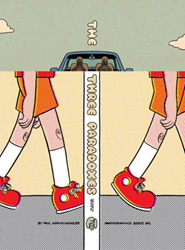
 The Three Paradoxes, by Paul Hornschemeier 7.5
In ‘The Three Paradoxes’, Hornschemeier offers us a (presumably autobiographical) glimpse into the life of “Paul”, a young adult visiting his parents for a few days. His main hobby is doodling, and the book mixes up his story with his own cartoons with his memories with a cartoon he once read with someone else’s back history.
In so doing, the style of the book changes dramatically throughout: the cartoon that “Paul” attempts to draw is rendered in blue pencil and looks clean and very nice; the present-time story is a very plain, straight-forward style; Paul’s memories are designed to look like old-school comic books, complete with Ben-Day dots; another character’s childhood conceived as a yellowed picture book; finally, the Zeno funnies look like a comic that was scanned and reproduced for this book. 
These stylistic choices are not only appropriate for the segments that they wish to represent, but they spruce up the overall content by giving us different flavours along the way. I found this quite refreshing, because much of the content is dry, so it gave me a reprieve by offering eye candy in exchange. I didn’t find this too gimmicky at all; it didn’t seem like it was done just for the sake of being “fancy”.
Not much happens to “Paul” during the course of this book, though; what we are seeing is about 12 hours of his time while visiting his parents. Hornschemeier unveils this character via the many other segments that he wove into the mix; using this approach, the reader can get inside Paul’s mind and start to understand his world. 
‘The Three Paradoxes’ is a very nice book, and it likely does more to explore its characters in a few short pages than many full-length books and films would. It’s well worth checking out. 
 thecriticaleye