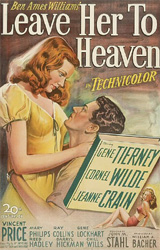
 Synopsis: Based on the best-selling novel by Ben Ames Williams, Leave Her to Heaven is a stylish psychological thriller starring Gene Tierney as Ellen, the stunningly beautiful wife of handsome writer Richard Harland, played by Cornel Wilde. Ellen panics as her perfect marriage unravels and Harland’s work and invalid brother demand more and more of his attention. Her husband becomes unnerved by her compulsive and jealous behavior. And when the people close to him are murdered, one by one, it is obvious that this dream marriage has become a full-fledged nightmare.
*************************************************************************
Going into this film, I had absolutely no idea what it was about. While you, dear reader, may peruse the synopses before checking out these blurbs, I hardly ever read them myself (I do scan them and edit them down prior to posting, however, for quality assurance). I have this thing about synopses, because, like many movie trailers, they are frequently conceived by nincompoops who reveal far too much about the story. 
*MAJOR spoiler alert*
|
In fact, the way things have spiralled downward in the last couple of decades, I’d half imagine that, if old classics were released today, their trailer or synopsis would quasi-completely lift the veil on what makes them so memorable: Psycho: Norman Bates (Anthony Perkins) has an identity problem. When he’s not busy flirting with pretty girls who sojourn at his roadside motel, he’s dressing up like his dead mummy and terrorising the locals. But, one night he goes too far and slaughters the one woman he should have left well enough alone: Marion Crane. With the law on her tail for having stolen a then-large sum of money from her employers, Crane (Janet Leigh) spells trouble for young Bates. Not only must he hide her body and remove all evidence of her existence, he now has to contend with private detectives and other enquiring minds who would surely reveal his many secrets. Oh, what’s a poor knife-wielding, psychopathic transvestite to do? From Alfred Hitchcock, the man who brought you ‘The Man Who Knew Too Much’, ‘The Man Who Knew Too Much’ and ‘Mr & Mrs. Smith’ comes ‘Psycho’, a shrill-sounding black and white film that will inspire you to shower with the curtains wide open. You will never look at a toilet the same way ever again! The Planet of the Apes: Based on Pierre Boulle’s classic science fiction novel, this space adventure takes Astronauts Taylor, Dodge, Landon and Stewart well over two thousand years into Earth’s future, back to a world now inhabited and run by super apes. Hunted and caught by these simians, Taylor (Charlton Heston) must befriend chimpanzee scientists Cornelius (Roddy McDowall) and Zira (Kim Hunter) in order to plan his escape. But little does he know that Dr. Zaius (Maurice Evans) has his gorilla soldiers at the ready, prepared to destroy all dissidence. Come ogle the half-naked men and women who are enslaved by evil apes! See the discarded remains of the Statue of Liberty, symbol for all civilization! Be amazed at how much Charlton Heston looks like the missing link! 20th Century Fox takes you to the 40th century in this cinematic extravaganza full of groundbreaking special effects and make-up work. Prepare yourselves for an invasion of “damned dirty apes” in ‘The Planet of the Apes’. It’s a mad house that will keep you riveted to the edge of your seat. The Empire Strikes Back: In this first of many follow-ups to the box office-shattering ‘Star Wars’, the Galactic Empire returns for revenge following the utter destruction of their ultimate weapon, the death star. With Darth Vader (David Prowse, but you’ll only remember James Earl Jones), Luke’s father, hot on their heels, Luke Skywalker and Han Solo (and a few arguably less interesting side-kicks) will be forced to part ways and fight their own battles, as Luke (Mark Hamill) learns the ways of the force with the help of a green goblin who sounds like Grover and Han escapes the peril of space potatoes by hiding in a giant penis with teeth. Aided by the only black man in the known universe, they will find a way to get away by the skin of their balls. Except for Leia (Carrie Fisher), who lost her mighty gonads sometime after the first adventure. And Solo (Harrison Ford), who will be sold off to a bounty hunter by Darth Vader for reasons unknown – and only after turning him into a giant chocolate bar. Relish as C-3P0 (Anthony Daniels) get what he richly deserves! Drool as Han fondles Leia “by mistake” in the Falcon! Laugh hysterically as R2-D2 (Breet Boop) is vomited into the air by a swamp thing! Don’t miss George Lucas’ ever-continuing epic saga in his most colossally dismal film ever! (Ahem… I got a little carried away, it seems. And now for your regularly scheduled programming… |
*MAJOR spoiler alert*
I knew absolutely nothing about ‘Leave Her to Heaven’. The only reason it was even on my slate was because Vincent Price is in it. Even how large of a role he might have was unknown to me. And, from what I’ve discovered over time, he could very well only have a cameo – leaving me to suffer in front of some fairly weak fare (‘The Invisible Man Returns’, for example). Thankfully, he turns out to have, if not a central role, a substantial one. 
Otherwise, this film gave me the impression of being a straight drama and, being no great fan of drama, it took much willpower for me to get to it.
It turned out to be a delightfully trashy treat, a thriller rife with melodramatic moments of pure delight: a neglected woman with attachment issues conspires to get and keep her husband to herself. Her jealousy and insecurities eventually eat away at her and render her completely delusional, untrusting and psychotic. 
Right from the onset, before things really go south, we get the impression that something is not-quite peachy keen with her: she lies and manipulates in order to get married, is unable to have frank, open dialogues with her husband – even asking their doctor to do her bidding for her. Not exactly smooth sailing, as far as I’m concerned. 
It doesn’t help that her husband is extremely negligent with respect to her: he is rarely alone with her from their wedding onward, always surrounding himself with her and his family members (including his young brother, a relationship that is fuelled by far too much brotherly love  ). He even finds a way to postpone their honeymoon – and not because he’s afraid of women, as evidence by their pre-nup rolls in the hay. Nah… he just seemed to take her for granted now, is all, and he had other things on his mind. No wonder she got insecure and desperately wanted some alone time with him – both for emotional and hormonal reasons (roooowr!!!
  )
)
In a sense, both are to blame for what takes place. She may have been fragile to start with, and all he did was trigger her time and again, obliviously driving her to the edge of madness. Having said this, she is absolutely, inarguably responsible for all the terrible things she does. In today’s courts, she might be deemed not guilty by reason of insanity, but some of the crimes she commits are premeditated and so horrible that it’s difficult to lay the blame on anyone else but her. 
I believe that it’s the first time that I’ve seen Gene Tierny in a film and I was pleased with what I saw. Given the era, one always has to expect some overacting, but she kept the theatrics to a minimum and managed to convey her character’s vulnerable yet sociopathic personality reasonably well. I was less impressed with Cornel Wilde, who came off as a weak Rock Hudson, blandly going through the motions and leaving no trace of his passage once the credits rolled. He’s so forgettable that almost anyone of any skill could have done the job as good if not better.
Meanwhile, Vincent Price hammered out a fierce performance. The exuberance that would later pull him into camp territory is hinted at here, just waiting to be let loose upon an unsuspecting public. Personally, I’ve never seen a district attorney as intense as this: he was like an erupting volcano, firing off one question after the next without taking a breather, basically pummeling his witnesses into submission. It’s a very notable performance, even if it defies credulity at times. And it is, without a doubt, the standout performance of this picture. 
The sense that I got while watching ‘Leave Her to Heaven’ was that the material, which was adapted from the Ben Ames Williams novel, had been pared down somewhat from page to screen. This impression mostly came from a lacklustre passage of time, wherein it wasn’t properly established just how much time had taken place between scenes. This is problematic in that we eventually discover that months had passed between certain sequences, or even that it had been a year that the couple were married. There is absolutely no way to know this in the film, whereas I suspect that the book would define this more clearly. In fact, many scenes are pasted together without finesse.
But, all in all, it was a relatively entertaining film, and I would watch it again without hesitation. Admittedly, though, it’s melodramatic and trashy, and I doubt that anyone would argue its finer qualities despite its massive box office success and the Academy Award nominations – that would be like saying that ‘Basic Instinct’ is Masterpiece Theatre. Sure, both have enduring qualities and mass appeal, but it doesn’t make of them anything but popular fare. I think that ‘Leave Her to Heaven’ is well worth the two hours’ investment, and it will make an impression, but it’s a flawed gem that could have been polished further. 
 thecriticaleye