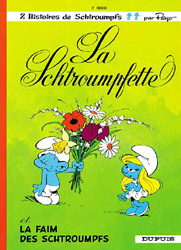
 La Schtroumpfette, by Peyo 7.75
In ‘La Schtroumpfette’, Peyo published what was then the most recent Smurfs episode, and packaged it with an earlier one for good measure:
1. La Schtroumpfette (Smurfs episode #13)
This one is a more complete story than most of the early ones, covering a lot of ground from start to finish, which is welcome. However, the onus on female stereotypes was slightly annoying to me. 
Whether that is an indication of the author’s perception of women or if he was being satirical is actually quite unclear, but my impression is the former – he plays for laughs all the possible clichés one can think of as though they were truisms. 
And yet, due to the overall story and the pure hearts of the Smurfs themselves, it turned out to be quite an enjoyable tale (imagine that: even despite its potential sexism!  ). Of course, one has to consider the context in which it was made (the era and the author’s cultural heritage) – in the same way as with the old Warner Bros cartoons or Fantasia’s now-controversial centaur segment. Context is everything in cases such as these.
2. La Faim des Schtroumpfs (Smurfs episode #7)
This one’s more sober than most, as it’s a survival story. But, being as it’s the Smurfs, it turns out that enough appropriate humour was injected into the proceedings to soften the blow of what could be a dismal tale. After all, famine is nothing to laugh at. Thankfully, Peyo manages to give us something that’s both poignant and pleasant at once. It could have been fleshed out a bit more, but it’s a pretty good piece.
There isn’t a great deal of difference in the rendering of the strips, so I imagine that either Peyo had by then fully formed his style or the earlier strip was redrawn for this book. I suspect the former, because it would be a LOT of work to redo everything just for continuity’s sake. 
Either way, it makes for a fairly enjoyable book, even though the first one is on the long side and isn’t nearly as gripping as other episodes are. Similarly, the second one is a tad on the short side, and would have greatly benefitted from a few pages more of development. But, all in all, it’s a pleasant read. 
 thecriticaleye