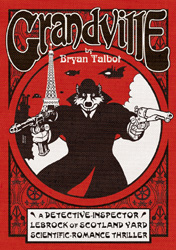
 Grandville, by Bryan Talbot 8.0
While the cover may not suggest it, ‘Grandville’ is more than a mere action comic. Sure, it has quite its share of action (more on this shortly), but it’s actually a mystery hiding in the shadows of political and criminal intrigue.
The setting is an alternate universe where France won the Napoleonic Wars and Britain has been annexed, its culture now blended with French, and the English language reduced to nothing but a relic of a distant past.
I had no idea what this book was before browsing the library’s shelves and picking it out from countless dozens. Its anthropomorphic steampunk quality (which I only just realized is the reverse of ‘cyberpunk’) is what caught my eye, and it was rendered in an appealing way that immediately piqued my curiosity.
The art isn’t the best that I’ve ever seen (the ‘Blacksad’ series is quite hard to beat!), but, considering that the author is also the artist, I must admit that he’s a well-wounded storyteller; very few books are put together so well, let alone by one person. 
I loved that the story was built on barely-concealed 9-11 references, even though it takes place in a distant, alternate past; I’d be curious to know if the parallels go deeper than my limited knowledge of history revealed to me. I also enjoyed the many Tintin references along the way, including characters such as Snowy Milou.
Talbot wisely adopted French expressions for his characters dialogues, which were translated quite literally (for instance, “Nom d’un chien!” became “Name of a dog!”). In current English, this means very little, so readers who are unfamiliar with the French language would find them curious indeed.
Even the names of some characters were cleverly culled from the French, such as the mole character Professor Tope (which sounds like “taupe”, which is French for mole) or the bovine Madame Moue (which sounds like “moo” in French).  The name Snowy Milou is also a French reference, in that Milou was the original name for Snowy.
My main issue with the book is that the lead character, Detective-Inspector Lebrock, has a predilection for killing everyone in his path. He starts the book by showing off his Sherlock Holmes-esque powers of deduction, but ends up using violence and far less wisdom than we’d have expected. I found his ruthlessness unnecessary and unpleasant. 
The ending was also a disappointment: everything just fell in place all too easily, wrapping up this immense conspiracy as if it was but a triviality. Meanwhile, Detective-Inspector Lebrock’s dramatic involvement wasn’t even noticed by anyone and he was able to leave the country scot-free.
Nevertheless, it’s a seriously good graphic novel and it’s worth giving it a shot (after checking in one’s suspension of disbelief!). As for me, I’ve since requested other Talbot books from the library, because I suddenly have a hankering to further explore this promising auteur. 
 thecriticaleye