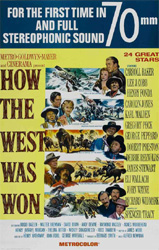
 Synopsis: With courage, sinew and conflict: that’s how the west was won. With three directors, five interlocked stories, some of movie history’s most legendary action scenes and a constellation of acting talent: that’s how How the West Was Won was filmed. Henry Fonda, Gregory Peck, Debbie Reynolds, James Stewart and John Wayne are among the big names in this big saga following a family’s move West through generations – marked by the spectacles of a heart-pounding raging river tide, a thunderous buffalo stampede and a bracing runaway train shootout. Via technological advances, this panoramic winner of three Academy Awards can now be seen with a resplendent, restored clarity eliminating its original “three-panel join lines” and in roof-raising Dolby 5.1 audio.
***********************************************************************
‘How the West Was Won’ had never appealed to me until I stumbled upon the Blu-ray edition of it and discovered that it had been released in Cinerama. I had read about Cinerama before, even though I’m too young to have ever experienced it, so that piqued my interest.
Upon my return, I immediately went online and read up the review of the BD. It confirmed that the film is actually shown in its ‘SmileBox’ format on the second disc, and the review paid high compliment to the work done to restore it for the Blu-ray upgrade.
I tend to dislike westerns, but on top of this I also dislike the idea of a western made before the mid-’60s. However, the appeal of seeing this film in its original format (albeit, without the concave screen that it was originally featured on) was a huge pull for me.
The BD was far too expensive for a simple dabble, such as it was – even second-hand. So I ended up getting a DVD copy from the library, but never got around to watching it. But then I found a guy who was selling a bunch of his BDs, including this one, for a mere 10$ a pop (this was a while back now, so it was still a good price).
I bought it. And it’s been on my list of priorities ever since. Seeing as I recently decided to watch some westerns, wholly due to my short phase of Coen Bros films, I wedged that sucker right into my schedule; I wanted to see the darned thing once and for all, even though I knew that I might not like it. It was the experience that I was eager for.
And what an experience it was! 
The Cinerama effect is like having a 4:3 picture (think of old-school TVs), but with stretched wings on both sides completing the picture. It creates the illusion of peripheral vision, which is kind of neat once you get used it. The side images are slightly skewed because of this, and you can tell that this was the 3D gimmick of its era: the filmmakers purposely had people and things moving across the screen and into the side parts.
For all intents and purposes, it’s the first Omnimax.
Not only is the film in the SmileBox format, giving it a wraparound effect, but the film was originally recorded in 7 channels of sound – compared to its peers, which were usually recorded in 1 channel. So the Blu-ray had a stupendous picture, which was processed to remove the dividing lines one would normally see (Cinerama required three projectors, to create its full picture. For more on Cinerama: http://en.wikipedia.org/wiki/Cinerama), but the audio didn’t need much tweaking to sound amazing.
Furthermore, ‘HTWWW’ was created as an event.
Back in the day, films that were close to three hours in length (or more!) were sometimes presented much like a play would be in the theatre: they had musical intros before the film began, interludes during a mid-picture break, and musical outros after the film. I quite enjoy having this feature on the BD because it recreates part of the experience of going to the cinema before multiplexes tore the soul out of it, making it more about consumption than a night out.
I may not have experienced Cinerama, but I’m aged enough to have seen films presented this in this fashion. However, short of setting up an actual home cinema (complete with curtains and theatre seats) and then asking strangers to come munch popcorn too loudly or act like boors in my home, this is as close as I’ll get to recreating the original show. Frankly, I think that this’ll do fine for now. 
Beyond the experience itself, which I recommend wholeheartedly, ‘How the West Was Won’ was pretty much what I expected. I’m happy to report that, on the scale that I run these films on, this is a pretty nice production: the few musical numbers were imbedded in realistic contexts (i.e. they don’t stop the show to sing and dance about mundane things), there is plenty of location filming (not just sets and rear projection) and what sets they do use were put together with care.
Old-school westerns had a tendency to be a little weak in the costuming department, however, and this is no exception. While it didn’t have bad guys with black hats and good guys with white ones, it had its share of unrealistic, if not laughable, elements.
My favourite was Henry Fonda’s character, who had such a bad moustache and hair that they looked like they were trimmed off the wigs of a b-movie production and glued to his head. Unbelievable! Plus he had the whitest shirt a cowboy could ever hope for. I kept wondering where he got THAT laundered… 
The dialogue is also slightly cheesy and unrealistic. James Stewart’s bits got a bit silly:
“I’m hungrier than sin and real peaceful like.”
or
“Eve, you make me feel like a man standing on a narrow ledge… comin’ face to face with a grizzly bear. There just ain’t no ignorin’ the situation.”
Stewart already had a pretty unique acting style, but, in this film, he’s not even at his best. So, combined with this ridiculous dialogue, you can just imagine what effect he produces on screen. It’s a shame, because I’m a big fan of Stewart’s work and I’m kind of embarrassed by this performance – so I would be wary of recommending the film in case it makes a bad first impression. 
Similarly, Gregory Peck, whom I’m quite fond of, is barely credible here. He gets by, but that’s about all one can say about his on-screen achievement here. The rest of the cast is quite okay, but there’s nothing worth noting here aside from Debbie Reynolds’ at times subtle, at times overly exuberant turn as a riverboat singer; her musical numbers were so full of eagerness, I wondered if she was trying to impress or grandstand.
Anyway, I don’t know why so many performances were sometimes lacklustre, but at least the acting’s lack of quality is made up for with a quantity of star power that is hard to match: Carroll Baker, Lee J. Cobb, Henry Fonda, Carolyn Jones, Karl Malden, Gregory Peck, George Peppard, Robert Preston, Debbie Reynolds, James Stewart, Eli Wallach, John Wayne, Agnes Moorehead, Thelma Ritter, and Spencer Tracy as the narrator. Even Lee Van Cleef and Harry Dean Stanton have uncredited roles in this one!!!
After the first few opening credits rolled, I couldn’t help but utter my disbelief as another big or familiar star was listed! How could they possibly squeeze so many actors into one film? Well, they did it by having multiple stories, covering a couple of generations.
Of course, having so many stories, and trying to tie it all together, must have been a real headache for the writers. Because of this, some pieces simply didn’t come together very well.
Case-in-point, there’s this terrific sequence after Stewart and Baker part ways: she’s going west and he’s going east, and he is victim of a guet-apens, losing everything. The river brigands then go set up their fake storefront up the river, ahead of Eve’s family – magically, without passing them along the way. The family is also ambushed, but Stewart heroically comes to the rescue – after having dog-paddled on a log up river!!!
*MAJOR spoiler alert*
Honestly, that part of the story is just one big tragedy, with more befalling them as they try to make their way west. The family loses everything and almost everyone dies along the way. At least that gets us rid of the little brat who couldn’t act worth his lunch (I’m happy to report that Bryan Russell made very few films afterwards!). The other main story is yet another melodrama, which includes getting attacked by injuns who suspiciously look like white folks in brown paint. 
*MAJOR spoiler over*
It all feels SO ridiculous. All in all, though, despite a convoluted plot, ‘How the West Was Won’ remains entertaining. We don’t see many of these types of films nowadays, but it’s no great loss, seeing as we have a couple of decades’ worth to choose from already – this was, after all, standard fare for quite a while.
‘HTWWW’ is mostly memorable from a technical standpoint, but it does have a few bits that won’t soon be forgotten. However, I’d chiefly recommend it if seen in its Cinerama format, with an appropriate set-up to go along with it. Otherwise, there are quite a few better (and frequently shorter! ) westerns than this.
PS: the BD also contains a feature-length documentary on Cinerama. If it’s anywhere as good as ‘The Cutting Edge‘ was on the ‘Bullitt’ BD, then it you’ll be hearing raves about it from me very soon.
 thecriticaleye