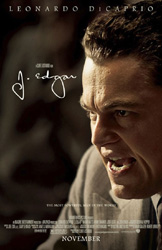
 Synopsis: As seen through the eyes of Hoover himself, “J. Edgar” explores the personal and public life and relationships of a man who could distort the truth as easily as he upheld it during a life devoted to his own idea of justice, often swayed by the darker side of power.
Oscar® winner Clint Eastwood (“Gran Torino,” “Million Dollar Baby,” “Unforgiven”) directed the film from a screenplay by Oscar® winner Dustin Lance Black (“Milk”). Academy Award® nominee Leonardo DiCaprio (“Inception,” “Blood Diamond”) stars in the title role.
***********************************************************************
J. Edgar 8.0
I walked into the cinema knowing very little about J. Edgar Hoover. I mean, we’ve all heard the rumours about his purported transvestism, and I knew that he was supposed to be quite the character, having been head of the FBI over numerous decades and many administrations.
But that’s about it.
The only reason I even saw the movie is because it was helmed by Clint Eastwood. It also features Leonardo DiCaprio in the lead, which is a plus for me. But, mostly, I went to see it because I had a free pass – otherwise, I would have waited (I’m not typically drawn to biopics, you see…).
All this to say that I’m in no position whatsoever to confirm whether or not this film is historically accurate. It could very well be that Dustin Lance Black, who also penned ‘Milk’, has created an elaborate fantasy about this iconic character – I wouldn’t know any better. 
Having said this, I did get the feeling that the script tries to be fair in its assessment of the man; the filmmakers make it clear that he was not exactly the most likeable person, being vain, arrogant, self-centred, paranoid, belligerent and uncharismatic.
But ‘J. Edgar’ also makes him out to be a well-intentioned man who lost his way through ambition and thirst for control – a man who wanted to do right for his country, but didn’t know where to draw the line. It doesn’t quite make him sympathetic, but it makes him less than a villain.
He was also, apparently, a very lonely man, having no friends or love for a large part of his life (which might explain his single-minded drive!), aside from his relationship with his mother. I couldn’t help but think of Norman Bates at times, especially upon Hoover’s mother’s death.
‘J. Edgar’ is a detailed sketch of his various political wranglings, crime-fighting and personal life. Over the course of over two hours, we get a good glimpse at his five decades with the FBI: what he started with, where he sets his sights and the power he had amassed by the time of his death.
It’s all helped along by a very smooth transition between various eras. Instead of going about it in a linear way, which probably would have been rather bland, Eastwood decided to jump back and forth between different parts of Hoover’s life. It’s not a new technique, obviously, but it was done so masterfully that I couldn’t help but be impressed. 
DiCaprio turns in a very good performance, but oftentimes it felt like exactly that: a performance. While he mostly got lost in the make-up, he didn’t always get lost in the man – at times his inner Jack Nicholson came forth instead.
His accent, in particular, got on my nerves – at times subdued, at times raging, I wondered the whole time if Hoover actually spoke that way; it felt fake. The heavily-accented narration, especially, was hard to deal with. 
His make-up work was also sometimes shoddy: although it could look somewhat natural, from time to time you could tell that he had appliances on his face. The worst would come when he needed to talk. It wasn’t always the case, obviously, but the greatest make-up offenses provided limited natural facial expressions.
This wasn’t limited to Dicaprio, sadly. Armie Hammer’s ageing make-up made him look like he was covered in a layer of chicken skin. Very strange. It got better as his character, Clyde Tolson, got much older and decrepit, but there were scenes where he looked like a reject from a b-grade sci-fi movie. 
Overall, however, ‘J. Edgar’ is an enjoyable film about an unlikeable man. It provokes reflections on democracy, political power, personal privacy, counter-terrorism, and a number of other subjects that are especially relevant in this day and age.
In that respect, I think that it’s a film worth seeing. If, by watching the birth and growth of the FBI, we can provoke discussion about what is acceptable in our society and move it to change in ways that are positive, then I think it’s valid.
I certainly don’t believe that ‘J. Edgar’ is an homage to the man, nor is it strictly a biopic. There’s more to it than may appear at first glance. Frankly, I’d love to watch this film with various groups of people to see what discussions would spawn from it afterwards. I’d be curious to see what they’d bring to and take from it. 
 thecriticaleye