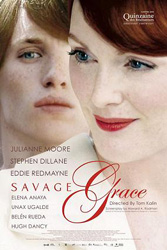
 Synopsis: Truth is more shocking than fiction.
Set across a stunning backdrop ranging from New York to Paris to Cadaques, Savage Grace is the incredible true story of a scandal that even remains shocking. The beautiful Barbara Daly (Academy Award-nominee Julianne Moore; The Hours, Boogie Nights) marries above her social class to the dashing heir of the Bakelite plastics fortune, Brooks Baekeland (Stephen Dillane of the HBO miniseries John Adams). The birth of the couple’s only child, Tony (Eddie Redmayne of The Good Shepard), intensifies the already volatile marriage. As Tony matures, he becomes an unwilling pawn in the psychosexual games of his parents, and the seeds for a tragedy of spectacular decadence are sown which challenge even the most shocking taboos. Tom Kalin’s (Swoon) return to cinema has dazzled and stunned audiences from the Cannes to the Sundance Film Festivals.
***********************************************************************
Savage Grace 8.25
‘Savage Grace’ is based on a true story. It takes place in various cities across Europe during the ’50s and ’60s, within the small circle of the Baekeland family.
The father, an accomplished, self-assured and wealthy man is seen early on frowning at his wife’s desperate attempts to mingle with high society. She is neurotic and desirous of status beyond the appropriate or without any consideration for her own family’s well-being.
Her son gets as much attention as she can muster, which is a lot, and he ends up becoming the centre of the universe outside of their social flirtations. This very much skews the family dynamics and it’s hardly surprising that the father eventually has had enough.
Then the family spirals even further out of control.
It’s hard to explain exactly what goes on in this film because it really is about the dynamics between the three family members. It’s pure drama, but it’s of the most riveting kind. As we delve deeper into each character’s psychology, we get to see just how fragile they are and what compels them to make the choices they do.
The performances were all exceptional. As unlikeable as most of the characters are, the actors managed to imbue them with a enough humanity to help us empathize a little bit. In fact, I found that they were easier to watch than even the actors themselves suggested in interview; to me, that speaks to the strength of their interpretations.
The filmmakers managed to recreate various eras with a small budget. I wouldn’t have noticed really, if not for the interviews I watched after the fact, so that’s a pretty good sign. I’m sure one could nit-pick about some inaccuracies, but at first glance it passes muster. Kudos to the production designer.
The film has an ending that I never, never anticipated, having never heard the original tale before. I only knew that, apparently, there was some scandal around this story – but I had no idea what to expect. I highly recommend avoiding any contact with the Baekelands’ story until after having seen this film, as it was much better not knowing what this was all leading up to.
 thecriticaleye