 Synopsis: One of the greatest anti-war thrillers ever, Fail-Safe stars Henry Fonda, Walter Matthau, Dan O’Herlihy, Larry Hagman and Fritz Weaver (in this film debut) as a group of military men on the verge of World War III.
When a military computer error deploys a squadron of SAC bombers to destroy Moscow, the American President (Fonda) tries to call them back. But their sophisticated fail-safe system prevents him from aborting the attack, so he must convince the Soviets not to retaliate. In desperation, the President offers to sacrifice an American city if his pilots succeed in their deadly mission over Moscow. A four-star techno-thriller that builds tension and suspense with every tick of the nuclear clock.
***********************************************************************
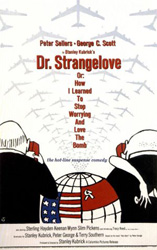 Synopsis: Stanley Kubrick’s classic black comedy about a group of war-eager military men who plan a nuclear apocalypse is both funny and frightening – and seems as relevant today as ever. Through a series of military and political accidents, two psychotic generals – U.S. Air Force Commander Jack D. Ripper and joint chief of Staff Buck Turgidson – trigger an ingenious, irrevocable scheme to attack Russia’s strategic targets with nuclear bombs. The brains behind the scheme belong to Dr. Strangelove, a wheelchair-bound nuclear scientist who has bizarre ideas about man’s future. The President is helpless to stop the bombers, as is Captain Mandrake, the only man who can stop them.
***********************************************************************
Fail-Safe 8.5
Dr. Strangelove or: How I Learned to Stop Worrying and Love the Bomb 8.25
I watched these films as part of a double-bill. The whole point was to provide contrasting takes on the same (or, at least very similar!) material. The former is a suspense film that wants to stimulate dialogue about the Cold War. The latter takes a satirical bend with the intention of highlighting human folly.
Both films were released the same year, were distributed by the same company, and neither were tremendous successes at the time. The unusual thing was that ‘Dr. Strangelove’ was released first (at Stanley Kubrick’s behest), which means that, by the time ‘Fail-Safe’ came out, they didn’t have an audience.
Our group watched the film in the more logical sequence: the serious one first, followed by the satire – which would make more sense after having been given a context by the first one. And also because, after ‘Fail-Safe’, I think one needs a little comedic relief; laughter being the best way to defuse tension.
Before I comment on each film individually, let me explain the gist of the story of both films:
Taking place at an undisclosed place in time, but clearly during the first peak of the Cold War (it should be noted that the Cuban Missile Crisis was in 1962 and these films were released in 1964) the United States loses control of a number of their bombers and are faced with trying to prevent their attack on the USSR – and, in the process, avert nuclear armageddon.
Both films are mostly character-driven and take place (largely) in two areas: the US War Room and in the cockpit of the main bombers (in ‘Fail-Safe’, there are four sets, but three are amalgated into one for ‘Dr. Strangelove’). They’re both black and white and utilize very little music (or, in the case of ‘Fail-Safe’, none at all).
***********************************************************************
Fail-Safe
I only saw ‘Fail-Safe’ for the first time a couple of years ago (or so). I didn’t even know that it existed until about maybe 5 years ago, when I saw it in a second-hand shop. Based on the cover art, which made it look cheap, like some crappy b-movie, I moved on quickly.
But it stuck in my head and I eventually read up on it enough to know that it’s highly regarded and that it might be worth checking out. Little did I know that this would seem so familiar to me; I had already seen ‘Dr. Strangelove’ a good dozen times but had no clue that these films were mirror images.
And yet, this made ‘Fail-Safe’ that much more gripping for me because a lot was already fleshed out in my head and I could focus chiefly on other parts of the film, such as the performances, the minutia, the general tone; I didn’t need to understand the main points of the story and it was liberating.
What I especially like about ‘Fail-Safe’ is that it could easily have been theatre or a live teleplay (coincidentally, George Clooney produced a 2000 remake as a live teleplay); it’s often very static, especially the scenes with the President (Henry Ford) and his interpreter (Larry Hagman). This makes us feel like we’re in the room with them – that we’re watching this transpire, that it’s NOT just a movie.
And that’s also why I think that its complete lack of music was a boon. By adding music, the film would have been melodramatic. By leaving us with dialogue and ambient noises only, it creates a much-needed reality. I’m a HUGE fan of film music, so I’m not saying this lightly – the film truly is more intense without it. It was a perfect decision.
The next great thing about this film are the performances. While they are from a different era and, thus, have to be considered contextually, key actors give all they have to give and have rarely been better.
For instance, Henry Fonda plays the perfect post-JFK President, when American idealism was still relatively high, before the Vietnam War and Watergate gouged cynicism into their collective hearts. He plays the character as a warm, thoughtful, intelligent, well-intentioned man who desperately tries to balance his duties as Commander In Chief and as a human being. I’d say it’s one of my top 3 favourite performances by Fonda (with ‘On Golden Pond’ and ‘Once Upon a Time in the West’).
Larry Hagman had a terribly difficult role to play. As the President’s interpretor, he had to translate simultaneously what the Russian President is saying but also give us a sense of his own internal life – which are two different head spaces. But what impresses me the most is how accurately he reproduced the choppy, hesitant nature of simultaneous translations; unless he literally had someone on the other end of the line to help create the moment, he had to pretend to be hearing one thing, decoding it in his head and relating it to the President all the while still listening to the continuous exchange. To be able to pull it off so credibly is quite the feat. I’d call this a tour-de-force performance from Hagman, and actor I’ve pretty much considered unspectacular until now.
Walter Matthau plays an intensely driven advisor with his own special take on the Cold War. He wants it to end, of course (he’s been established as hawkish but not completely mad), but he naturally wants the US to win. His paranoid diatribes against the “red menace” are so reminiscent of what was propagated during the ’50s that you couldn’t help but understand his motivations: utter, deep-seated fear (it is said that the character is based on Herman Kahn, political scientist). While Matthau sometimes has a tendency to ham it up, here he manages one of the best dramatic turns of his career; the controlled fire in eyes speaks volumes.
There are a couple of scenes at the beginning that seems a little bit superfluous at first glance but that help to define the characters later. For instance, Matthau has an early scene that seems utterly pointless, but it serves the define him as the bad guy, yet not a completely immoral character. Another character, a general, is shown in a extremely emotional moment with his drunk parents, which serves to justify his breakdown later, being unable to deal with all the baggage in one day. And yet another is shown leaving home wishing he could spend more time with his family, setting up the poignancy of a decision the President later makes.
While the movie often overplays some of these elements, it doesn’t quite hit you over the head with them – it’s just enough to make you reflect upon all the questions and all the possible sides of the debate. It tries very hard to cover most views, and I believe that they succeeded relatively well in portraying most of them as neutrally as possible.
As a conversation piece, or at least as a thought-provoker, it is brilliant film-making; you can’t help but want to discuss the many views espoused during these two hours. In fact, that’s precisely why I wanted to make an evening of it: because I knew it would invariably get people talking. It’s hard not to, especially when you’re lived through the Cold War (or even just a part of it). Imagine if people had seen it then.
Nota bene: the last quarter of the film is crucial to the appreciation of this film. If you are considering watching ‘Fail-Safe’, please do your best to avoid any fore-knowledge of its ending. I can guarantee that your experience will be much more memorable if you have that “will they or won’t they?” uncertainty going in; this will make the film a REAL nail-biter – and a completely unforgettable one at that.
***********************************************************************
Dr. Strangelove or: How I Learned to Stop Worrying and Love the Bomb
I first saw this movie some 15 years ago. Back then I was trying to make up for lost time, having never had a family VCR and rarely renting one – so my exposure to cinema was mostly limited to outings at the cinema and rentals with friends (at their house, obviously).
The library had a this crazy collection of laserdiscs, and they were free to rent, so I bought myself a laserdisc player for dirt cheap and begun binging. ‘Dr. Strangelove’ wasn’t immediately on my radar, but the artwork always gave me pause, and the name kept showing up in Mayfair flyers or movie literature. So I eventually gave it a shot.
I didn’t get it.
I thought it was an alright film, but the humour completely escaped me. I don’t even think I knew it was supposed to be satirical, so it didn’t even feel like I was missing something; I just didn’t understand what the fuss was all about. But I made myself a copy anyway, figuring that I would likely check it out again later. It was, after all, a Stanley Kubrick film.
It went in high rotation as background noise for sleeping because it was good enough to be entertaining while I was struggling to nod off, and quiet enough that it wouldn’t give me any jumps and derail me off my route to lalaland.
That’s when I started focusing on the dialogue. Since I had my eyes closed (and, presumably, had my back turned too), that’s all I could focus on. That’s how I discovered that much of the humour is hidden in the dialogue, in little comments, inflections in a character’s voice, absurd exchanges, …etc.
Then I became a fan. A BIG fan.
I must have seen this film about a dozen times at this point – so much so that I don’t even know if I can rate the film clearly anymore. For instance, when I think of ‘Dr. Strangelove’, I immediately think it should be a 9.0, and yet after watching it yesterday it felt like an 8.25 to me. So I’m going with the latter, even though I would normally say that it’s one of the most important films of all time.
What makes it so significant is its intention, which is to thumb its nose at the madness of the nuclear race (thereby raising essential questions), and the ability with which it manages to achieve its aims. Backed by some masterful performances, I’d say it really deserves its acclaim after all.
The movie opens up with a title sequence that should leave the viewer with an understanding that the filmmakers will dare to trample over then-taboo subject matter. I totally didn’t understand it upon first viewing, of course, but the montage of mid-air refueling of bombers to the sound of romantic music is meant to evoke an unusual kind of eroticism.
The overt absurdity of this sequence should have elicited giggles, and warned me of what to expect, but it didn’t – it left me quizzical. There are other, less-nuanced moments throughout the film that should’ve done something but also didn’t. Thankfully, even the more nuanced bits do now; in fact, they’re my favourite.
For instance, in two out of three roles that Peter Sellers tackled in this film, the subtlety of his facial expressions, the slightest pitch change in his voice, and every shift of his body are intended to tell us something about the character’s identity and/or his emotional state at that current moment. Not only does he take on three characters, but he does so with such skill it’s amazing he didn’t win an Academy Award for it (although he was, thankfully, nominated).
My favourite of his three characters is his slightly nebbish American President. In my group, someone suggested that he was a little bit Woody Allen-esque, and I’d have to agree. He’s not nearly as neurotic, but you get this sense that he’d be better off as a school principal than as “Leader of the free world”. To me, the scene where he tries to navigate the various moods of a drunk Russian President on the phone is absolutely classic.
His British Officer character is stuffier and drier, but there’s a fair bit of dark humour layered in his every movement from the moment that he discovers that his immediate superior has started the countdown to doomsday and that he’s powerless to do anything about it. Sellers’ ability to show us some of the character’s hidden terror and yet on the surface keeping him fairly straight is genius. The Officer goes through various emotional changes as the clock counts down and they all ring true, sometimes played with just enough humour to slice the intensity of the real situation.
His characterization of Dr. Strangelove, to me, has always been his weakest. I find the character to be a caricature and he’s played far too over-the-top compared to all the other actors in the film. Granted, this probably puts the spotlight on him and justifies naming the movie after him, but there are scenes towards the end that always hurt. Having said this, I was very pleased to find that someone in my group found the things I loathe about the character extremely funny; this proves yet again how complicated humour is, as everyone has their own specific sense of humour. And it vindicated the performance in my eyes a little bit, actually.
George C. Scott plays a very proud general who has to contend with what he considers to be some absolutely silly decision-making from the higher ups, including the President. He’s extremely vocal about his opinions and makes quite an @$$ out of himself in the process. What’s great about this performance is his body language and the way he flirts between stoicism and utter discombobulation. How he wasn’t nominated for an Academy Award defies belief – he completely leapt off the screen and the film would have been significantly poorer without him in it.
Sterling Hayden needs to be mentioned because his role is essential to the story. As the General who starts the crisis, he plays a man become so paranoid by all the anti-communism propaganda of the previous decade that he resolutely takes charge of the situation, with the full intention of knocking out the enemy before they completely inflitrate and corrupt the country. Hayden plays him sober, intense, and with the required commitment. While he doesn’t display his madness overtly, his dialogue betrays his state of mind.
Contrary to ‘Fail-Safe’, ‘Dr. Strangelove’ is hardly about minutia; how everything unfolds isn’t nearly as important as the way the characters react to it. So it has the weaker story development of the two. However, it’s often more subtle in its message than ‘Fail-Safe’ in that the absurdity elicits questions out of any thinking audience – whereas the other one clearly intends to put a spotlight on what it wants to tackle.
The fact that it manages so well at being thought-provoking and yet poking fun at one of the darkest moments in modern history is quite the achievement. How it mirrors the seriousness of the then-current political climate with its dementia is no easy feat indeed. It’s essential film viewing for anyone interested either in cinema or history. To paraphrase a reviewist I read recently: “if you don’t love this film you’re either ignorant or you haven’t seen it yet”. While the use of “ignorant” is a bit harsh, I understand his sentiment.
 thecriticaleye